
Introduction
People spend roughly two and a half hours a day scrolling social media. Compare that to the average e-commerce site visit — under four minutes. That gap says a lot: attention lives on social apps now, and if selling doesn’t happen there too, you’re leaving money on the table.
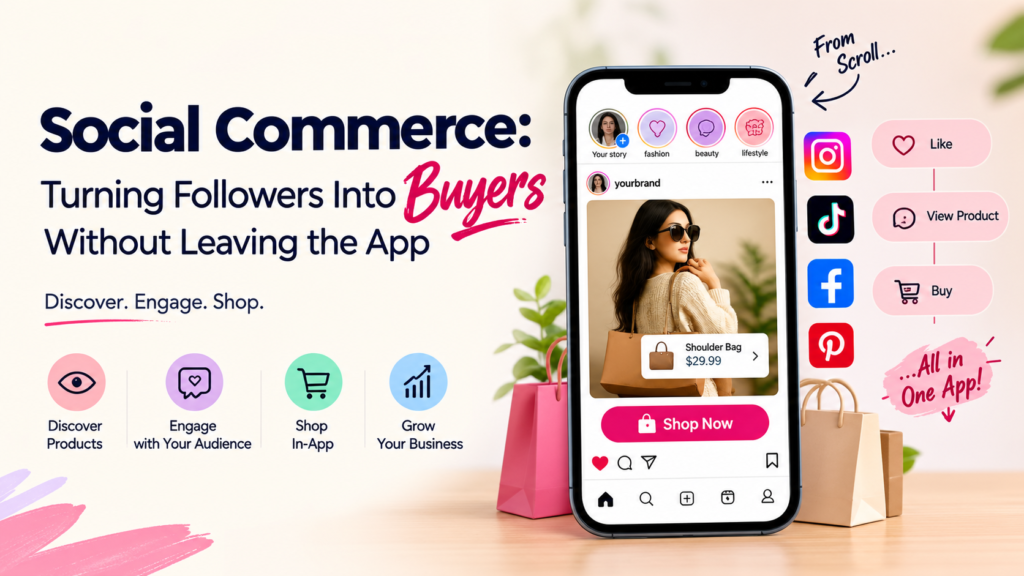
Social commerce is shopping that happens right inside the app you’re already scrolling. No “click here to visit our website,” no new tab, no lost momentum. You see a product in a TikTok, tap it, and you’re checking out before the next video even loads.
This post covers why that shift is happening now, which platforms are actually good at it, what features move people to buy, and how to put together a strategy — plus the mistakes that quietly kill momentum before it starts.
Why This Is Happening Now
For years, social media’s job was simple: get you curious enough to click away and buy somewhere else. That model is starting to feel clunky. Instagram, TikTok, Pinterest — none of them want you to leave anymore. They want the whole transaction happening on their own turf, because every hop to an external site is a hop where they lose visibility and you lose interest.
It comes down to friction. Every extra step between “I want this” and “I bought this” is a chance to lose the sale. Cut down the checkout steps and conversions jump — sometimes dramatically. Three taps and done beats five taps and a login screen you have to dig up a password for.
Trust is the other half. Younger buyers trust a creator they’ve followed for months way more than they trust a polished ad from a brand they’ve never heard of. They’ve watched that person review products, use them daily, complain when something’s disappointing. Put a buy button right next to that kind of trust, and it works better than most traditional ads ever could.
The Big Platforms, and What They’re Good At
Each platform leans into shopping a little differently, so it’s worth knowing where to put your energy instead of spreading thin.
TikTok Shop lets sellers tag products in videos and run live shopping events. Live selling hits especially hard — watching a real person hold up a product and answer questions on the spot converts in a way a pre-recorded ad never will. Beauty, fashion, food, and home goods all do well here.
Instagram and Facebook Shops share a catalog. You set up a Shop tab, tag products in Reels and posts, and in some regions people can check out without opening a browser. If you’re already running Facebook ads, this is a natural next step — good for lifestyle brands, clothing, anything that photographs well.
Pinterest is different. People show up already planning or half-decided on a purchase. Shoppable pins turn a photo into a direct buy point, and visual search lets someone snap a picture of something they like and find similar products. Home decor, fashion, and DIY are Pinterest’s lane.
What Actually Gets People to Buy
Shoppable posts and product tags solve the most basic problem: “wait, where do I buy that?” Simple fix, outsized payoff — plenty of interested buyers give up if the path isn’t obvious.
Live shopping builds momentum a static post can’t match. Someone’s demoing the product in real time, answering real questions, and people buy while it’s happening because there’s urgency baked in.
User-generated content works because it’s peer validation, not marketing. Someone who looks like you, using the product in their normal life, does more for trust than any ad campaign.
Creator storefronts give brands ongoing visibility without paying for a fresh campaign every time. The partnerships that work are the ones where the creator genuinely likes the product — people can tell when it’s fake.
And don’t overlook chat-based selling — DMs, WhatsApp Business. A fast, helpful answer to “does this come in blue?” can close a sale right in the conversation. Smaller brands especially benefit here.
Putting a Strategy Together
- Look at where your audience already hangs out. Check what earns saves, shares, comments — let that guide where you build first.
- Get your catalog and shop tabs set up. Connect through Shopify, WooCommerce, or a manual feed, and keep it clean. An outdated shop with wrong prices kills trust instantly.
- Make content meant to convert, not just entertain. Show the product in use, get ahead of obvious objections, and don’t make it look like a commercial.
- Work with micro-influencers. Creators with 5,000–50,000 followers often outperform celebrities here — better trust, better engagement, more affordable. Audience overlap matters more than follower count.
- Retarget the people who almost bought. Anyone who tapped a product tag and bounced is a warm lead, not a lost cause. Showing them that exact product again is one of the better-ROI moves in this whole space.
Mistakes That Trip People Up
Treating the shop like an afterthought is the big one — broken links and stale catalogs make people bounce and never come back.
Ignoring the free analytics each platform hands you is another. Click-throughs, product views, conversions should steer your content, not sit unread in a dashboard.
Being too salesy is a quieter killer. Content that feels like a TV commercial gets scrolled past. What works feels like a normal post that happens to be sellable.
Slow mobile checkout rounds it out. Too many steps or a laggy page loses people right there. Check your own checkout on your phone — most brands never bother.
How to Know If It’s Working
Keep an eye on three numbers:
- Conversion rate — what percentage of viewers actually buy
- Average order value — how much people spend per purchase through social
- Engagement-to-purchase rate — how many people go from liking a post to buying
Each platform’s dashboard covers shopping-specific data reasonably well. GA4 with UTM tracking, Shopify’s social reports, or tools like Triple Whale and Northbeam fill in the gaps.
More followers isn’t the goal. Understanding what the followers you already have are doing on the way to a purchase — that’s the goal, and the harder question to keep asking.
Wrapping Up
Social commerce isn’t an extra channel to bolt onto what you’re already doing — it’s quietly becoming the default way people shop. The path from “I saw this” to “I bought this” keeps getting shorter, and every platform is racing to shrink it further.
Take a real look at your own setup. Is the catalog current? Is the content built to sell, or just to look nice? Are you tracking any of this? Pick the one platform where your audience already spends time, get the fundamentals right, and expand from there.
Want a quick gut check? Go look at each platform where you have a presence and check three things: is the shop live, is the catalog current, and does checkout actually work on your phone. That’s where you start.